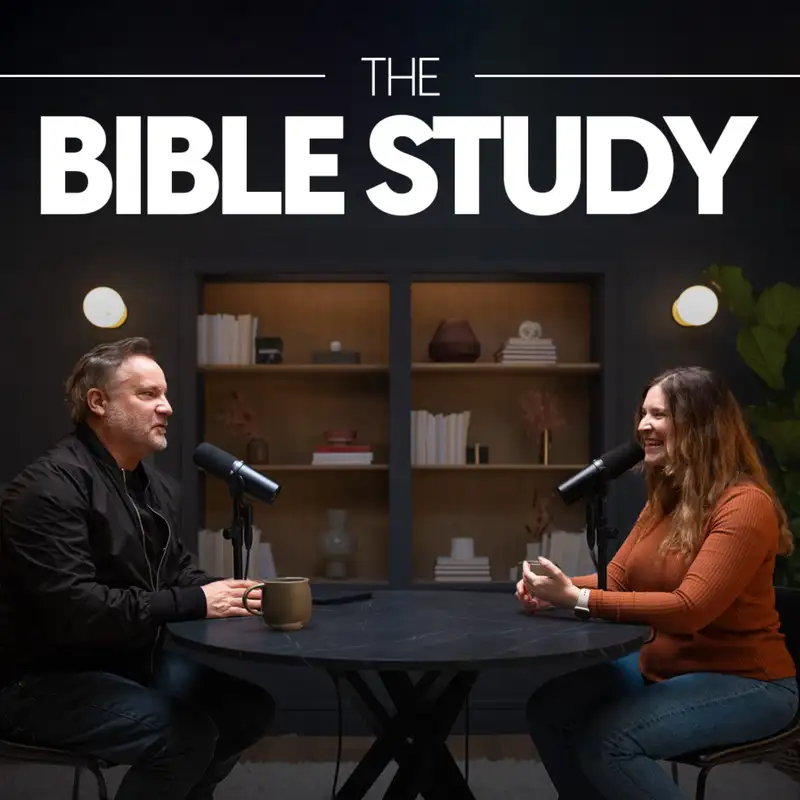
Curt Harlow [00:00:00]:
Hello, my friend and welcome to the Bible study podcast, Dena Davidson. Dena, how you doing?
Dena Davidson [00:00:05]:
I'm so excited because some of my favorite people are here.
Curt Harlow [00:00:07]:
Yeah, why? We have a bunch of people, studio and audience. You guys make some noise. So now you're here.
Lincoln Phelps [00:00:12]:
Okay.
Curt Harlow [00:00:13]:
There you go. See, we're not. I guess there's a camera on you too. So sit up straight. Sit up straight, everyone. Okay, Dena, who's here with us today?
Dena Davidson [00:00:21]:
That's so fun because Malia asked how loud can we be? Like, can I click my pen? And then we just had everyone yell. So yeah, good job. Okay, who is here? So it is preview day at Thrive College. And so these are all of our students checking out Thrive College, which is a nine month, or actually two year program, nine months at a time discipleship and internship program we have here at Bayside Church. And so all of these lovely people are checking out to see whether they are going to join us next year for Thrive College.
Curt Harlow [00:00:49]:
So I would say my favorite thing we do at Bayside and then we have someone to help us facilitate because we're going to on this special Thrive College Bible study podcast smash up, we are going to take questions.
Dena Davidson [00:01:04]:
That's right.
Curt Harlow [00:01:05]:
From our Thrive students. And who's going to help us do that? Dena?
Dena Davidson [00:01:08]:
That's right. Well, before I introduce this guy who's just incredible. If you have been following what God has been doing in the United States, God is working revival among the younger generation. And so we thought it would be incredible to host said younger generation 18 to 25 and ask them or in the midst of everything that you're doing to pursue God, what questions do you have? What questions does your generation have about the Bible? How to read it properly and what it says. And so to host that conversation, we brought on no less than the Lincoln Phelps. Yeah, okay. I feel like my name disease was like gonna destroy that. We are such good friends, Lincoln Phelps.
Dena Davidson [00:01:55]:
And. And honestly, we just refer to him as Link. And Link, tell us a little bit about what you do as an intern here at Bayside.
Lincoln Phelps [00:02:01]:
Yeah, here at Bayside and Thrive College, I am a worship intern and a social media intern and this is my second year of Thrive College and it's been the best experience of my life.
Dena Davidson [00:02:11]:
Awesome.
Curt Harlow [00:02:11]:
What's your favorite part?
Lincoln Phelps [00:02:13]:
I would say this is a very different answer than most people. I'd say that I feel like we learn so many social and emotional skills that like, even adults the age of like 40 to 50 would have never learned in their life. And I think like, we learn emotional Maturity, Like, a lot faster than most kids do in this program, so.
Curt Harlow [00:02:32]:
Awesome. What's your least favorite part? Honestly?
Dena Davidson [00:02:36]:
Not knowing my name.
Lincoln Phelps [00:02:37]:
Favorite part, Probably Dena. Not knowing my last name.
Curt Harlow [00:02:42]:
No.
Dena Davidson [00:02:42]:
Sorry about that. Sorry. Hey, you were a great student in my ethics class, but, yeah, forevermore. Just. Link.
Curt Harlow [00:02:48]:
There's a whole lot of you just all blur into one person for us. Link.
Lincoln Phelps [00:02:51]:
No.
Curt Harlow [00:02:52]:
Are all of our students here with us at preview day? No, some of them are doing another activity.
Dena Davidson [00:02:57]:
Oh, yeah, they're playing kickball.
Curt Harlow [00:02:58]:
Wiffle ball, I heard in the Windle ball. So in other words, this crew is the smarter crew and the more biblically astute. And the more biblically astute. Wiffle ball or Bible? We saw how you chose. All right, we got.
Dena Davidson [00:03:11]:
We took note.
Curt Harlow [00:03:11]:
We got. We got questions. Link.
Lincoln Phelps [00:03:13]:
Yeah, we're going to start this one out with a bang. We got. Why did God create Lucifer knowing he would deny him?
Curt Harlow [00:03:22]:
Why did God create Lucifer knowing he'd deny him?
Dena Davidson [00:03:25]:
Same reason he created me, knowing that I would sin. I think that God, throughout the scripture, God is a big fan of free choice, and he so values freedom that he's willing to allow people to make the wrong choice, because to be in a loving relationship with him, he knew he had to present us with freedom. And so if you think it's a good thing that humans are free, then you think it's a good thing that Lucifer was free to rebel. Like, just think about it. I want you to think about your favorite dystopian movie, right? Like, do you have one, Curt? I know you love dystopian.
Curt Harlow [00:04:01]:
Gosh, there's too many to think. Too many choose from. Exactly the pressure.
Dena Davidson [00:04:06]:
It's all right.
Curt Harlow [00:04:06]:
1984.
Dena Davidson [00:04:07]:
Okay, that. Is that a movie? It's just a book.
Curt Harlow [00:04:10]:
But it is also a very good movie. So super depressing.
Dena Davidson [00:04:13]:
1984. Anyone in the audience read it. Hey, there you go. Wow, this is the smart crew.
Curt Harlow [00:04:18]:
Yeah.
Dena Davidson [00:04:19]:
So 1984 is all about an authoritarian, authoritarian government exerting control over its citizens. It's the big premise in every dystopian novel. The bad guy is always the one who is limiting freedom. And why do they do it every time? Their argument is, it's for the common good. Right. It's in your benefit that I limit your freedom in these ways. So if you are watching or reading 1984, watching those dystopian movies and thinking I am on the side of freedom, then you think that God made the right choice in creating Lucifer and giving him the freedom to rebel, because that freedom to Rebel is what is making us free to be in relationship with God. Now, what's the right answer?
Curt Harlow [00:05:02]:
The Mockingjay answer is what you're saying.
Dena Davidson [00:05:05]:
Yes.
Curt Harlow [00:05:05]:
Yeah. Okay, good. I, I, I volunteer as tribute. I agree with everything you said. The only thing I'd add to it is it is difficult to answer the question exactly why God made Lucifer. Because God does not want us, nor does he give us a lot of information about Lucifer. So there's a lot of conjecture about Lucifer. There is a lot of inference about Lucifer, how Lucifer was created, what he did in heaven.
Curt Harlow [00:05:32]:
Some people say he was the master choir director, but we don't really have a lot of main and plain direct passages. And the lesson there link is that the things we are meant to master in the Bible are not demons. And so Lucifer being the chief one and all the other, it's, it's really sketchy what gets said about them. And God's very purposeful on that. So I would say God's position is solidly what you need to know is not this.
Lincoln Phelps [00:06:01]:
Yeah.
Curt Harlow [00:06:01]:
And so we don't have a lot of God's inner dialogue about that. We don't have a lot of dialogue between Lucifer and God about that. We can inference and as Dena did, did so well from a philosophical point of view, we can have conjecture, which I would agree with with Denis. Conjecture. I, I put it like this. I used to travel quite a bit and when I would come home, my, I would make all my children hug me and my adolescent boys would come up and, you know, 13, 14, and they would kind of give this really awkward, like, we don't like to hug dad anymore because we're too cool. And, and I would make them hug me. I would force them hug me.
Curt Harlow [00:06:40]:
Yeah, I'm like, you want to eat? You're going to hug your dad like you missed him. My middle child, Maddie, who is five years younger, from wherever she was in the house, she would come running the second she heard the door and she would throw herself in my arms and she would hug tightly and she'd say, daddy, I missed you every day. Missed you every moment. So glad you're here, Daddy, and I love you so much. Which hug did I enjoy the more? The one given with freedom or the one given because it was required? Well, obviously the one given in freedom. This is God. God could create you in a way where you had to hug him or he could give you the choice to hug him.
Lincoln Phelps [00:07:25]:
That's good.
Curt Harlow [00:07:26]:
And the choice is what God is really looking for. He really wants the authentic Relationship.
Lincoln Phelps [00:07:31]:
Yeah.
Dena Davidson [00:07:31]:
It's good.
Lincoln Phelps [00:07:32]:
Thank you. Yeah, I love the way you said that.
Curt Harlow [00:07:36]:
Just I hear a lot of pen clicking right now. I just want to say, no doubt, Malia. That's an inside joke, you guys. That's.
Lincoln Phelps [00:07:42]:
Anyway, I guess, like, some thoughts even about that I've been reminded is, like, what a privilege it is that our God doesn't force us to love him.
Curt Harlow [00:07:48]:
Yeah.
Lincoln Phelps [00:07:49]:
So, yeah, we're gonna go to. Second question. How do you know your calling in life?
Curt Harlow [00:07:56]:
I'll take a first stab at this one, Dena. You can. You could give the follow up. How do you know you're calling in life? Well, first thing I would say, especially to this age group, but let's be true. If you're listening, you're in your 40s, 50s, or 60s, I would try to think, how do you know you're calling in this season? Because I do not. I do not like the idea. I don't mind the idea of I have a lifelong calling. I feel very called to this age group.
Curt Harlow [00:08:23]:
This is my favorite thing I do at Bayside. I have an affinity with this group. They have an affinity with me. I think that'll be true when I'm 88. But I don't like saying I have this calling period, and now I'm no longer listening to the Holy Spirit about what I should be doing. I think God has given me different callings in different seasons. And oftentimes when I feel the Holy Spirit's direction, I think, this is it. This is really what he's prepared me to do.
Curt Harlow [00:08:52]:
And then after that season gets over, he sends me in another direction and I go, oh, no, no, this is it. And what I was doing in that last season was all preparation for this. So the life of the Spirit, as Paul describes it over and over and over again in the Epistles. And as we see him live out in the Book of Acts, like, literally at every turn on the map in Acts, he's. He's listening to the Spirit. Where should we go? We're going. We got a. We got a dream.
Curt Harlow [00:09:21]:
We're going to Macedonia. Now, as you watch that, the power of the Christian life is listening and following to the Holy Spirit. The power of the Christian life is not courage or willpower, self control. The power of the Christian life is doing what the Holy Spirit is enabling you to do. So the first thing I would say to that is just be open. Be very open. You don't have to get this issue settled. Also, I would say when you're 18 or 25, you should play utility infielder.
Curt Harlow [00:09:53]:
The way to know what your calling is, do a lot of things. I was a. A children's pastor for one year. One year. One, you know, I won because I hated it. I hated it. Not the children, the parents that wouldn't. That, you know, had high demands and low participation.
Curt Harlow [00:10:13]:
Now I lead a children's pastor and I lead a children's department in our campus. And it gives me much greater empathy for what that job is that I got to do it. So part of the way to discover what your calling is is go out and try a bunch of stuff. Figure out what you don't like. Yeah. And then figure out what you know. For whatever reason, when you do that, the Holy Spirit just seems to empower you more. It comes easier to you.
Curt Harlow [00:10:40]:
You see some fruit.
Dena Davidson [00:10:43]:
I think also everything Curt just said falls under the category of your specific calling. So when we are talking about calling, usually we're talking about what's my specific calling? Meaning what am I supposed to do Monday, Tuesday, Wednesday, Thursday, Friday, Saturday, Sunday to build the kingdom of God. That's our specific calling. The Bible is obsessed about our general calling. And before you ever try to get clear on your specific calling, you need to be as obsessed as the Bible is about defining your general calling. We know from the garden we were called to work. We know we are called to follow Jesus. We know we are called to make disciples.
Dena Davidson [00:11:20]:
We know that we are called to live a life worthy of the calling that we have received. We are called to be sanctified. There's all of these crystal clear general callings mean they're shared by every believer. And it's only by being obsessed with the general calling that you're going to be empowered, as Curt is saying, to. To be faithful in your specific calling. One of my favorite teachings you ever gave thrive college was at the end of their second year experience. You said you're probably wondering what you should do next year. And here's the question that I want you to ask.
Dena Davidson [00:11:55]:
What will make me closer to Jesus and what will build God's kingdom? Like, those are your two questions. Not what college should I go to next, not, you know, what job should I take? Not who should I date? Those are all specific questions. Your question that Scripture calls you to be obsessed with is what will make me close to Jesus and what will build the kingdom?
Curt Harlow [00:12:16]:
You're right. I was brilliant. I was really good. So good.
Dena Davidson [00:12:20]:
Good job. Bring that one back. Okay.
Curt Harlow [00:12:22]:
All right, like, what else?
Lincoln Phelps [00:12:23]:
All right, we got another question. What does the Bible say? About self harm. And then something I'll add to it specifically is like what does the Bible say about a Christian who took their own life?
Curt Harlow [00:12:33]:
It's very good. Yeah, I think you should go first on this one, Dean.
Dena Davidson [00:12:37]:
Sure, sure. How about I take self harm and you take.
Curt Harlow [00:12:40]:
Okay, yeah. Good.
Dena Davidson [00:12:42]:
I think the Bible calls us to treat our bodies as temples. I think the Bible calls us to love one another. And it assumes as we love ourself. I think that we are to know that we are not our own. We were bought with a price, therefore to honor God with our body. So if there's any action that you're doing that you would not do to Jesus himself, you shouldn't be doing it, period. And that, that I hope is the crystal clear answer that everyone has. Now.
Dena Davidson [00:13:13]:
People that self harm usually don't need that theology talk. People that self harm are in an immense amount of pain and they're looking for release. And to that I think the Bible offers comfort and help. And I, I think if you're in the presence of someone or you are someone that is struggling with self harm, then I hope you know that God dearly loves you. Even on your worst day when you are incredibly sinful and harming your body. God loves you. He saw that day. He sent his son to die for you on that day.
Dena Davidson [00:13:47]:
Your actions don't define your relationship with God. Jesus defines your relationship with God. And, and there is help available in the body of Christ. Please reach out. That's what the body is meant to do. We're meant to share our burdens with one another and to carry them for one another. And then also know that the spirit of God is there to comfort. He deeply cares about the pain that you're in.
Dena Davidson [00:14:12]:
And it is not his plan to leave you alone in that pain. He wants to rescue you from that pain.
Curt Harlow [00:14:20]:
Very good. The topic of suicide is very intense one. So first of all, let me just say if you have had suicidal ideation or a loved one of your struggles with suicidal ideation or you have had a person in your life commit suicide, there is never going to be a completely satisfying intellectual answer to this question to what is such a deeply sad, a deeply grieving event. So I think we have to separate the conversation about how do I grieve this? Should I be mad at my loved one that committed suicide? Can I have hope for the eternity of my loved one that committed suicide? Those are questions that are on the. What's my response to this when it happens in my life? And that's a Different sort of pastoral and theological conversation. Then there's the theology of it. What does the Bible actually say about this? So there's pretty much two views. Most of the church has viewed the idea that when the Bible says thou shalt not kill, it includes self harm, it includes suicide.
Curt Harlow [00:15:44]:
So is it a sin to take my own life? Most of history, Christians would say yes. Then there's a secondary question which is, then what is the consequence of that sin? So we have to ask the question this way. If we accept that taking my own life is a sin, thou shall not kill. We have to ask the question, what happens to any sinner when they sin while dying? Does the person with very, very painful leukemia, who doubts God profoundly because of the suffering they go through, do they lose their faith? Does end stage disease, leukemia, pancreatic cancer? Does this cause when? As a pastor, I frequently get this counseling. The last interaction I had with my loved one before their fatal car accident was one of anger and it was a sinful conversation. We let ourselves sin. So when I die, if I'm sinning, does that nullify the work of Christ? Well, my clear answer would be no. No, it doesn't.
Curt Harlow [00:17:03]:
I. I don't believe in the last rites. I don't believe that praying a prayer over you at the end to make sure all the things that you haven't told God about are covered. I believe that we are saved by faith through grace. When I get to heaven, I will not give God an account of my last moments. I will give God a plead. And I will either plead his forgiveness based on my works or will plead his forgiveness based on Jesus works. And so does suicide condemn us to all eternity apart from Christ? No, absolutely not.
Curt Harlow [00:17:45]:
If we've put our trust in Christ, then Christ's work covers over a multitude of sins. And so then why would someone who puts their trust in Christ. Here's the next question. Why would someone take their own life? I will tell you this. There's little in life, maybe nothing in life more painful than profound anxiety and depression. There is a place I've learned as a pastor where depression is so acute and anxiety is so acute, like, like relatives will say, how could they have done this to me? And I always say, no, they didn't. They weren't thinking about you. As crass as that sounds, they weren't thinking.
Curt Harlow [00:18:34]:
They were feeling. And what they were feeling was incredibly crushing, very, very difficult. And then more and more in our culture too, as we have the incredible blessing of pharmaceuticals that help with depression. What we've learned about those pharmaceuticals is that especially in adolescence, they can create a moment in the brain where that sort of empathy for self is muted. And oftentimes we will see increased suicidal ideation in people on certain antidepressants. And this can happen in adults. I've seen in adults too, but it's predominantly with adolescents. For the people that get relief out of those medications and those therapies, it's incredible.
Curt Harlow [00:19:25]:
Godsend. They're not always perfect. And when they first started coming out, there was much resistance to even putting warnings on. But now the data is pretty clear. So there's a wide scale. From pharmaceutical to deep wound and tragedy and brain structure, There's a deep scale of those things that can create a moment that is so hard sometimes people cannot find hope out from under it. Now, I'm careful to leave you with this last thought. Is there any depression that is so deep that it has to end? No, there's no depression so dark, so deep that it has to end in the taking of one's life.
Curt Harlow [00:20:23]:
Sadly, that does happen. But in every case, I believe it's preventable. In other words, I believe even though in those that are in hard to treat suicidal ideation, there is hope. Corrie 10 Boom, the famous World War II concentration camp survivor who literally spent a time in the darkest, deepest dungeon that man can create in Nazi Germany, was famous for saying, there is no pit so deep that God's love is not deeper. And so it's just a matter of will you and I compassionately, prayerfully find ways to intervene and help those that carry very deep and hard to carry anxiety and depression?
Lincoln Phelps [00:21:17]:
For sure. It's really good. Thank you. This next question, I'm. I really like this question because I've had like, plenty of friends in my life who have, like, accepted Christ and like, even seen them, like, living for Christ. And then I look at their life now and like, I don't see them like, even like, remembering about their commitment to Christ at all and just living a completely different life outside of Christianity. And the question is, what does the Bible say about, like, once saved, always saved?
Curt Harlow [00:21:47]:
Well, clearly that is the truth. And everyone who thinks the opposite of that is completely wrong in a heretic.
Dena Davidson [00:21:53]:
Glad to solve that.
Curt Harlow [00:21:54]:
We had a giggle. Okay. Back when I was in seminary, we used to have this thing called. I'll tell you this little story, then Dena can give her answer. We have this little thing called pizza and theology. And twice a week we would eat pizza with the. Our little cohort that was all in the same theology classes. We would.
Curt Harlow [00:22:16]:
Our little professor proctor over. We would go and we would talk over lunch about our reading. Where we up to date on our reading. And some theological reading is very difficult. We had this one particular book we were reading by a guy named Blesh, German guy, and I had to look up every other word, literally. And I was often behind on my reading. And on the way to lunch, I would say to my fellow cohort, I would say, hey, let's, let's get this meeting off trail so we don't have to talk about where we are in our reading, because I have no thing to say because I haven't read it yet. Well, how do we do that? I said, you start the argument and you say, once saved, always saved.
Curt Harlow [00:22:58]:
And I'll say, no, you could lose your salvation. And we'll get into an argument. This worked many times. This is a great way of getting out of theological homework. So, yeah, I got an answer. But Dena, you go ahead.
Dena Davidson [00:23:14]:
Yeah, I think this is a definite case where there's equal weight of biblical evidence on both sides of the question. So I can think of a lot of verses that say, for it is by grace you have been saved. This, not of yourself. It's a gift of God. And so if it's God's work, then there's nothing that you can do later that messes up that work. It's God's salvation. He thought of it, he initiated it, he paid for it, he saved you. It's all him.
Dena Davidson [00:23:45]:
So, no, you can't mess that up. And then I think of other verses where it says, work out your salvation with fear and trembling. And those who say to Jesus, lord, Lord. Like, lord's a really great word, right? Lord, Lord. That seems like they've got some good theology. But he says, depart from me, you evildoers. I never knew you. And so I literally think if you do a deep dive study, you will only come to the conclusion that there is a lack of clarity in the Bible on this question.
Dena Davidson [00:24:14]:
Yeah, this is not a Bible verse, but here's my. There are some things that God purposefully leaves unanswered in the Bible. He purposefully leaves tension because that tension is better for us than the clarity. So, for example, once saved, always saved, then someone would be more inclined to go live however they want, right. And not worry about sanctification. And God's like, oh, they're not following me, right? No. God knows that when you are running away from him, you are harming yourself and you are harming others. And so he purposefully perhaps even though it might be once saved, always saved, leaves it unclear so that people will work out their salvation with fear and trembling.
Dena Davidson [00:24:59]:
On the other hand, let's say that, oh no, you can lose your salvation. Like, if you do not persist in following God and being a disciple, then perhaps you never were a disciple or you are no longer a disciple and you got to stay faithful until the end. Imagine if that were true and then God communicated with clarity that that were true now then every time you go to bed, Lincoln, you're kind of doing a calculus of whether you've been faithful enough and no longer are you trusting in the sufficiency of Jesus as your Savior. You're back in a place of fear and like, I don't know whether I'm saved or not. So I think this is not a Bible verse. This is Dena saying, I think on purpose, in God's wisdom, he left that tension in the Bible and it's a really good thing. So many theological debates that we waste our time on truthfully are fun conversations, but they're really about our need for clarity. God is actually not so much about the clarity as he is about faith.
Dena Davidson [00:25:59]:
Right. So he's clear about a few things over and over again in Scripture. The main and plain things, lots of unclarity around other issues. I think we're meant to live with that tension and have our faith in Christ and in what he has clarified, not in what is unclear.
Curt Harlow [00:26:17]:
Perfect. Love it. Dr. Bob Boutley, who's Calvinist and a great scholar with a very deep Southern accent, which makes it one of my favorite. He'll say, we want clarity. God wants tension. And I think in this issue there is tension. Ephesians 1, 13 and 14.
Curt Harlow [00:26:34]:
Believers are sealed with the Holy Spirit as a deposit, guaranteeing their inheritance. Well, you can never lose that salvation, can you? Well, let's look. Here's the Same author. Galatians 5:1:5, warns that those seeking to be justified by the law have fallen away from grace.
Dena Davidson [00:26:54]:
Thanks, Paul.
Curt Harlow [00:26:55]:
Same guy? Same guy. You know, what's interesting about this hot topic here is it's only been a hot topic since the Reformation. You know, the early Christian fathers. This was not it. It gets mentioned, but it wasn't the church divider that it is now. And I think it's because primitive Christianity, rightfully so, is more comfortable with mystery in the nature of God than we are. So mystery sometimes is a cop out. How does salvation work? It's a mystery.
Curt Harlow [00:27:26]:
How does the end times work? It's a mystery. Sometimes it's a cop out. Just for I don't want to learn the doctrines. But when it comes to actually God's eternal nature, the fact that God invented time, that before time, which is oxymoron, before time there was God, that is something I do not understand. So do I add anything to my salvation? Do I save myself at all? No, it's all a work of grace. Jesus did not say it is finished except for Curt's part to pray that prayer right before the I raise my hand table. No, it is finished. He does it all.
Curt Harlow [00:28:00]:
For me to decide to accept him is a work of grace. Do I have free will and is it my decision and am I morally responsible for making the decision and not making a decision? Absolutely. How do those two things work together in the mind of God? I. I don't know. Yeah, I don't know. And I will tell you, I'm glad I don't know cuz no one wants to serve a God. With my SAT scores, I would like to serve a God. If you know one of the signs of a cult is when they can tell you the mind of God in one paragraph or less.
Curt Harlow [00:28:32]:
So how does this work in God's eternal sovereignty? Don't know. Happy to look and find out. When Paul says, now we are ones that look as into a dim mirror, but then we will see face to face. When I meet God face to face and I am in that realm, maybe I'll understand a little bit more of how this tension works. For now, my job is to live a godly life because check it out. So let's say your friends authentically accepted Christ and now they have truly fallen away and they're without Christ, they lost their salvation. Or let's say they had an experience, but they really didn't accept Christ. They were just faking it and they never were saved.
Curt Harlow [00:29:12]:
And that means they're falling away. And without Christ. Both situations, they're falling away.
Lincoln Phelps [00:29:19]:
Yeah.
Curt Harlow [00:29:20]:
In both situations they're headed towards the same direction. So while we fight about the mechanism here, my more word of number one. Am I living a life that proves I have authentic faith?
Lincoln Phelps [00:29:33]:
Yeah.
Curt Harlow [00:29:33]:
According to James. And whether these guys had it and lost it or never had it at all, I'm deeply concerned that they would find their walk with Christ.
Dena Davidson [00:29:43]:
Yeah.
Curt Harlow [00:29:44]:
Regardless of the mechanism that brought them to that place.
Lincoln Phelps [00:29:46]:
For sure.
Dena Davidson [00:29:47]:
All right, what about this? What if I throw a curveball? We have like one minute left. But what if every single one of us answers the question, why should you read your Bible? I would love to Hear, hear. Lincoln's answer. We can close with Lincoln's answer.
Curt Harlow [00:30:02]:
Okay.
Dena Davidson [00:30:02]:
Yeah. Okay. You want to go first?
Curt Harlow [00:30:04]:
I'll go first. Yeah. You should read your Bible because it will motivate you to watch this podcast, which will increase my viewership and, and in humility, create a bit greater platform for my. No, I'm just joking. You know, here's why you should read the Bible. Life is really, really hard and I can't teach you how to handle every situation, but I can teach you to where you can find how to handle every situation. So five years ago, when in the worst part of COVID what I discovered was the Bible verses I memorized as a 17 and 18 year old man that the guys like Michael Mowry and Ron Jacobson and Ron Urkes drilled into me and made me memorize. Those Bible, those verses, those passages, those truths are the things that came up to the surface in the hardest moments of my life.
Curt Harlow [00:31:04]:
So, you know, life is hard and it doesn't get. Every stage is hard, just hard in a different way. And having the truth to guide you through that and guide you more importantly, not just through it, but to Jesus through it. I just don't know how I would do it without it.
Dena Davidson [00:31:21]:
Yeah, that's good link. How many questions would you say we didn't get to? Just an estimate.
Lincoln Phelps [00:31:26]:
I would say five.
Dena Davidson [00:31:27]:
Five. Okay.
Lincoln Phelps [00:31:28]:
Yes.
Dena Davidson [00:31:28]:
So we answered like three questions and there are five, like important, pressing conversations about the Bible. And I get there's a lot of reasons to read your Bible that would be my reason today is because God is such a great communicator that he will speak directly to you and everything that you need to know for a holy godly life is contained in his Word. And I hope that you don't leave here disappointed that your question didn't get answered. I hope it makes you really thirsty to go read God's word so that he can answer your question. But as we're wrapping it up.
Curt Harlow [00:32:04]:
Oh yeah, I have an idea. So link you at the final say.
Lincoln Phelps [00:32:08]:
Okay.
Curt Harlow [00:32:08]:
Why should you read your Bible before he gives his answer? Read the five questions. And Dena, you and I have to answer each question.
Dena Davidson [00:32:19]:
Oh my God.
Curt Harlow [00:32:20]:
With two or less words. Two or less words. Okay, two or less words.
Dena Davidson [00:32:28]:
Nice. Sure, my sister.
Curt Harlow [00:32:29]:
And then link you close this and your answer will probably be so you get a better answer than you just got right here. Okay.
Lincoln Phelps [00:32:35]:
If you are already in hell, can you decide to follow Jesus and get saved from hell and go to heaven?
Dena Davidson [00:32:41]:
Hopefully, so
Curt Harlow [00:32:45]:
probably not.
Lincoln Phelps [00:32:51]:
So guys, what resources do you recommend to dive deeper into the Bible's context?
Curt Harlow [00:32:57]:
Bible dictionary.
Dena Davidson [00:33:04]:
Yeah. Do you know. What's your answer? It's three words.
Curt Harlow [00:33:12]:
We'll give you a dispensation of grace.
Dena Davidson [00:33:14]:
No.
Curt Harlow [00:33:15]:
Oh, yeah. Good. I like this game.
Dena Davidson [00:33:17]:
Read whole.
Curt Harlow [00:33:19]:
Read whole.
Dena Davidson [00:33:20]:
Read whole.
Lincoln Phelps [00:33:22]:
Why does God desire our worship?
Dena Davidson [00:33:28]:
Is God
Curt Harlow [00:33:32]:
you healthy?
Dena Davidson [00:33:33]:
You healthy? I like it.
Lincoln Phelps [00:33:35]:
All right, this one says it's only for Curt, so. Dena, we don't really. That's really rude about your life.
Dena Davidson [00:33:40]:
So coming at you, whoever I'm gonna
Curt Harlow [00:33:43]:
have, Lincoln, Tracy, I'm a little nervous.
Lincoln Phelps [00:33:45]:
And they actually probably don't care about Dena's life because what's something in your life that really affected your relationship with God? What made it grow?
Dena Davidson [00:33:54]:
I'm so disappointed.
Lincoln Phelps [00:33:55]:
One sentence.
Curt Harlow [00:33:57]:
Hard times.
Dena Davidson [00:33:59]:
Hmm.
Lincoln Phelps [00:34:00]:
How do we biblically, as a whole prove other religions wrong?
Dena Davidson [00:34:06]:
Say it again.
Lincoln Phelps [00:34:06]:
How do we biblically, as a whole prove other religions wrong?
Dena Davidson [00:34:12]:
Jesus. Jesus resurrected. If you want me to use 2.
Curt Harlow [00:34:19]:
Bearing fruit.
Lincoln Phelps [00:34:23]:
Why is forgiveness so hard? And how does the Bible help us through forgiving stubborn people?
Dena Davidson [00:34:38]:
Why is forgiveness so hard?
Curt Harlow [00:34:43]:
Revenge. Strong
Dena Davidson [00:34:48]:
self. Death.
Lincoln Phelps [00:34:51]:
After reading the Gospels, where is the best to begin reading? Next?
Dena Davidson [00:34:57]:
Reading the gospels, Galatians,
Curt Harlow [00:35:08]:
Acts.
Lincoln Phelps [00:35:10]:
All right, we got two more. How do the literary style styles in the Old and New Testament affect the way Scripture was revealed to us so much?
Curt Harlow [00:35:21]:
Affect the way your scripture was revealed to us? How does that. Like. Like. Did you mean how did the styles affect how we read them or how God's plan for getting this. The Bible? You can't do that in two words. You got to pick one. How. How we.
Curt Harlow [00:35:44]:
How God got us the Bible. Oh, Out of literary. Sam. Whole person.
Dena Davidson [00:36:01]:
Is that it?
Lincoln Phelps [00:36:02]:
How do you spread the gospel to atheists?
Curt Harlow [00:36:09]:
Bear fruit.
Dena Davidson [00:36:12]:
Ask questions.
Curt Harlow [00:36:14]:
Very good.
Lincoln Phelps [00:36:15]:
That's really good.
Dena Davidson [00:36:16]:
So, Lincoln, we know you. Despite how I messed up your last name, we know you. Speaking of bearing fruit, you are bearing fruit in a generation that is more prone to be found anywhere but church. Every time I'm here, and I work here, you don't. But every time I'm here, you're here with a smile on your face, faithfully serving the Lord. Many in your generation have chosen to discard the Bible. Can you just speak a word to them? Why should they read the Bible?
Lincoln Phelps [00:36:49]:
How I like to think about it is if Curt didn't spend any time with his wife and didn't get to know his wife, he wouldn't continue to fall in love with her. And if he didn't, like, know anything about her, he wouldn't even have a reason to marry her and how I think about it is it if I don't spend time with Jesus, like, intentionally one on one in the secret place, I'm not going to want a relationship with him because I don't know his character. And the Bible specifically says the word of God is living and breathing. And like, the word is literally God. And I think, like, he's given us this whole book with every answer we ever need to know. And why don't we use that to shape our whole entire life? Because I bet you, like, every single answer we need is in that book. And like you said, like, he left out, like, clarity for things for a reason. So, like, I know my king, like, put everything I needed in this book and everything I need to know about how Jesus lived his life, everything I need to know about God's character is in this book.
Lincoln Phelps [00:37:45]:
And if I want to be intentional with him and know him, I have to read about him and spend time with him.
Dena Davidson [00:37:51]:
So, so good. Thank you for sharing that.
Curt Harlow [00:37:53]:
All right, so what if you're out here, Dena, and you're thinking to myself, how do I become one of these super cool Thrive College students? Like, Link here. What do you do?
Dena Davidson [00:38:02]:
Yeah, go to our website, mythrive college.com and there's a place where you can just contact us. It goes straight to our incredible team. We have Amy Zilsdorf in the house. She will be the person helping connect you. And honestly.
Curt Harlow [00:38:16]:
So you couldn't get Link's last name right, but you got Zildorf.
Dena Davidson [00:38:19]:
Zdorf. That's. That's so fair. That's so entirely fair. Yeah, I'll be paying for that one forever. But um, honestly, the biggest reason you should come to Thrive College is you want to be in a room with these people who I'm looking at right now, incredible people that Jesus has called and he's now equipping and are going to make a huge difference building the kingdom of God. So yeah.
Curt Harlow [00:38:42]:
Mythrivecollege.com and by the way, if you're outside the state of California, our weather is so much better than your weather.
Dena Davidson [00:38:49]:
Amen.
Curt Harlow [00:38:50]:
You could be right here, right now playing Wiffle ball with a bunch of them. Don't care about March. Wiffle ball in March. Think about that. Cold weather states. All right. Hey, all of you guys that are regulars watching the Bible study podcast, I'm so glad that you gave us some time today. Thanks again.
Curt Harlow [00:39:06]:
The loyal comments on YouTube. The. The loyal followers really appreciate you. If you're new, keep tuning in. Actually, we week by week. Take the actual sermons that are being taught on the 10 different campuses here at Bayside Church and we do a deeper dive on them while asking the question, what's the right way to get the original meaning out of the passages of Scripture? Inexhaustibly fun. So like, subscribe, follow, do all that stuff so that we get more people studying the Bible. Thanks for joining.